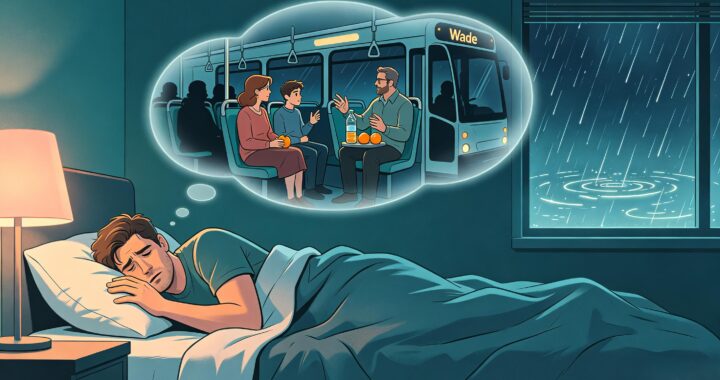

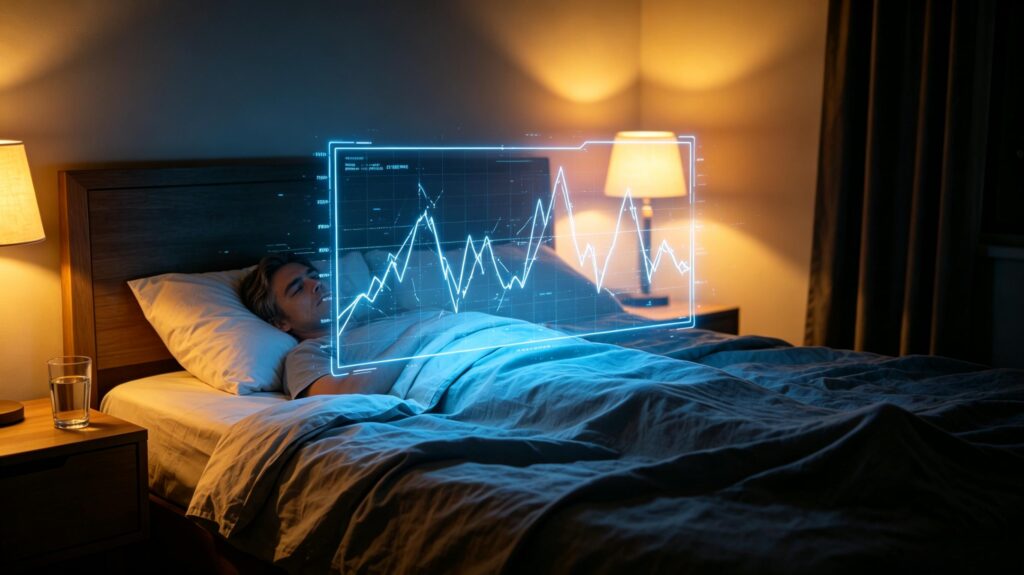
Dream Recorded: June 14, 2026
Full Overnight Sleep Timeline (June 14, Day 5, June 14, 2026 Independent Sleep Log)
Pre-sleep variables: Tea consumed throughout the afternoon and evening; regular daily melatonin supplementation was fully suspended.
- 00:15: Natural sleep onset without difficulty.
- 02:55–02:59: First midnight arousal to use the restroom, remaining fully awake for four consecutive minutes.
- 04:48–04:49: Second brief nocturnal bathroom wake-up, staying conscious for one minute.
- 05:05: Complete, lucid awakening with zero residual dream imagery or subconscious fragments retained.
Post-Waking & Nap Routine
- I practiced soothing guided meditation upon waking, nearly drifting back to sleep mid-session. I attempted an extended morning rest window from roughly 5:10 a.m. to 7:00 a.m.
- Nap sleep state: The entire rest period consisted of extremely shallow, fragile light sleep. Minor ambient noise easily jolted me awake, with no REM activity or retrievable subconscious visions generated at any point.
- 07:30 onwards: Permanent wakefulness following breakfast. All subsequent attempts to re-enter stable sleep cycles failed entirely.
Objective Sleep Tracking App Data Breakdown
My professional sleep monitor captured full structural shifts in last night’s sleep architecture, supplying objective numerical evidence to validate my subjective physical sensations:
Total sleep window: 00:15–07:04
Verified full awakenings: Two distinct bathroom-triggered wake intervals at 2:55 a.m. and 4:48 a.m., alongside numerous subtle unmarked micro-arousals logged automatically within the sleep curve graph.
Sleep stage distribution breakdown:
- Deep sleep (purple trace): Severely limited, split into disjointed short bursts with no sustained continuous deep-sleep blocks.
- Light sleep (pale purple trace): Dominated the entirety of nightly rest, forming the only consistent stable sleep phase.
- REM sleep (pale blue trace): Drastically truncated and sparse. REM duration was particularly insufficient during early and mid-night cycles, lacking the extended late-night REM windows required to encode and solidify dream memories.
- Awake state (yellow trace): Clear markers for the two bathroom wake-ups, plus frequent brief intervals of elevated cortical arousal.
The quantified monitoring data corroborate my subjective experience perfectly: overnight sleep remained disjointed, shallow, and unstable. No full closed sleep cycles are formed, and sustained REM activation never occurs—the direct root cause of total dream amnesia upon waking.
Personal Reflection & Controlled Experimental Contrast
Last night’s sleep quality forms an accidental natural controlled trial, creating a stark measurable contrast against Day 4, June 13, 2026’s stable melatonin-aided rest:
- Day 4, June 13, 2026 (Regular melatonin supplementation): Sustained, lengthened late-night REM periods, consistently producing four complete, vivid, fully retrievable dream sequences.
- Day 5, June 14, 2026 (No melatonin + evening tea intake): Frequent nocturnal awakenings, minimal deep-sleep occupancy, almost no uninterrupted functional REM cycles, and a fully blank dream log.
The experimental divergence is pronounced and unambiguous. I plan to export granular sleep-stage metrics—including total REM runtime, deep sleep percentage share, and arousal frequency—to conduct quantitative comparative analysis of melatonin’s regulatory impact on sleep architecture and dream generation capacity.
Authoritative Evidence-Based Scientific Analysis (Comprehensive Academic Module)
This fully dreamless, fragmented sleep pattern is not a random nightly sleep fluctuation. It represents a predictable physiological outcome stemming from two overlapping stressors: abrupt melatonin circadian withdrawal, paired with caffeine and diuretic stimulation from evening tea. Four bodies of peer-reviewed institutional research below explain every recorded symptom in this sleep log.
1. Melatonin’s Circadian Stabilization & REM Sleep Modulation Mechanism
Authoritative Source: Sleep Foundation
Official Link: https://www.sleepfoundation.org/melatonin
Melatonin acts as the human body’s primary circadian pacemaker hormone. Peer-reviewed sleep research confirms that exogenous melatonin does not merely induce drowsiness; it reorganizes core sleep architecture at a structural level. It shortens sleep onset latency, cuts down unprompted midnight micro-awakenings, markedly extends uninterrupted deep-sleep stretches, and critically prolongs late-stage REM sleep windows. Human dream formation, subconscious scene construction, and long-term dream memory consolidation exclusively take place during sustained REM cycles. Steady baseline melatonin levels therefore directly boost dream density, visual clarity, and post-waking recall ability. Abruptly discontinuing melatonin removes the body’s primary circadian anchor signal, triggering cortical instability, erratic cycling rhythms, and severe REM compression—which fully accounts for the complete loss of dream imagery recorded on Day 5, June 14, 2026.
2. Evening Tea Caffeine Suppresses Deep Sleep & Inhibits REM Onset
Authoritative Source: PMC (PubMed Central) Clinical Caffeine Sleep Research
Official Link: https://pmc.ncbi.nlm.nih.gov/articles/PMC3805807/
Evening tea contains moderate caffeine and polyphenol compounds that deliver prolonged central nervous system stimulation. Clinical datasets confirm that late-day caffeine intake blocks adenosine receptor buildup, obstructs the natural transition from light to deep sleep, and maintains persistently elevated cortical arousal throughout the night. This biochemical trap locks the brain into a permanent shallow-light-sleep dominant state, eliminating the lengthy preparatory deep-sleep cycles necessary to trigger high-quality REM dreaming. Without stable deep-sleep cycling, the brain cannot initiate full REM rebound responses, resulting in fragmented sleep architecture unsuitable for dream production.
3. Tea’s Diuretic Effect: Sleep Cycle Fragmentation & Dream Memory Interruption
Authoritative Source: Mayo Clinic Sleep Physiology Guidelines
Tea polyphenols and caffeine accelerate nighttime fluid metabolism and boost nocturnal urine output, triggering involuntary midnight awakenings. The Mayo Clinic’s research on sleep disruption verifies that any arousal lasting longer than 60 seconds mid-cycle permanently severs the continuity of unconsolidated dream memory traces. The two verified midnight wake events (four minutes and one minute of wakefulness) split my overnight rest into multiple incomplete cycle segments. Every interruption resets the brain’s sleep staging state, erases unprocessed subconscious residual signals, and prevents cumulative dream imagery storage—the core reason no dream fragments can be retrieved at dawn.
4. Shallow Morning Nap State & Failed Post-Waking REM Recovery
Authoritative Source: National Sleep Foundation Napping Physiology Research
Official Link: https://www.sleepfoundation.org/healthy-sleep/naps
Early-morning shallow naps taken under high cortical arousal cannot reconstruct intact full sleep cycles. Research demonstrates fragmented residual sleep after premature waking only sustains low-intensity light-sleep activity, lacking sufficient neurophysiological depth to spark secondary REM activation. Even extended nap durations cannot generate or store retrievable dream memories under unstable shallow rest, leading to a full day with zero recoverable dream content.
Core Scientific Conclusions for This Dreamless Sleep Trial
- Sudden melatonin withdrawal eliminated circadian stabilization, compressing REM sleep and raising cortical sensitivity overnight.
- Evening tea caffeine blocked light-to-deep sleep transitions and suppressed endogenous dream-generating neurological pathways.
- Diuretic compounds in tea induced midnight awakenings, fully fragmenting sleep cycles and wiping nascent dream memory traces.
- Post-waking shallow naps failed to restore REM activity, locking in total dream amnesia for the entire rest period.
Targeted Personal Sleep Optimization Plan (Derived From This Controlled Experiment)
Drawing from the clear experimental contrast and supporting scientific evidence within this log, I have developed tailored sleep adjustment strategies:
- Restrict all tea consumption to hours before 3 p.m., eliminating overnight diuretic pressure and residual caffeine interference.
- Resume intermittent cyclic melatonin supplementation (avoiding daily continuous intake) to re-stabilize the circadian rhythm and restore a complete, unbroken sleep cycle architecture.
Disclaimer
All sleep tracking records, quantified sleep metrics, and experimental conclusions featured in this chapter constitute 100% authentic firsthand personal monitoring data, archived solely for private dream journal storage and neutral non-commercial academic reference. This material does not function as a medical diagnosis, sleep disorder treatment protocol, or formal psychological counseling guidance. Readers experiencing long-term insomnia, circadian rhythm dysfunction, or persistent inability to recall dreams are advised to consult licensed sleep medicine specialists.
Original Standard Price: $4.49
Blog Exclusive Discount Price: Only $3.49
This discounted rate is only available for visitors from my blog. All other external sales channels will use the full original price of $4.49.